Background
Over the years, OCD has become a term casually used to describe orderly people. Through pop culture and media, it has been portrayed as a quirky personality trait, perhaps most famously by Monica in FRIENDS, Sheldon in Big Bang Theory or in Khloe Kardashian’s series KHLO-C-D.
But OCD isn’t an adjective - it’s a serious mental health disorder causing people to suffer from intensely negative and intrusive thoughts as well as repetitive actions – and the first signs typically show when you’re a teenager. However, most people don’t seek help as they aren’t aware of the symptoms. Yet, for young people, early diagnosis and treatment is essential.
Task
How could we create OCD awareness and make teens seek treatment before their OCD worsens?
The challenge was to change the perception around OCD stereotypes, and to help suffering youths break the vicious cycle at an early stage by using a creative approach that would speak directly to them.
Solution
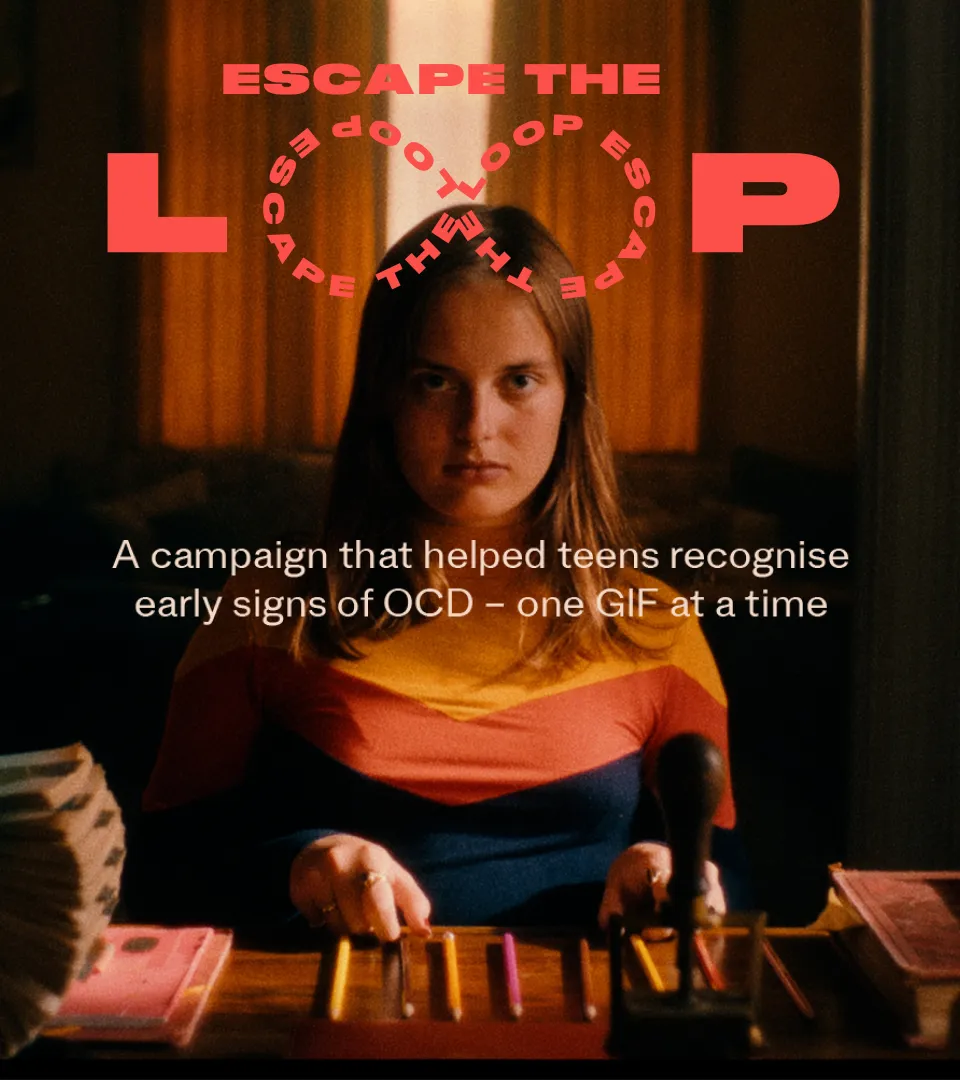
From the insight that youths often use GIFs to express a feeling or emotion, combined with the fact that a GIF per definition is a repetitive loop, the GIPHY- based campaign “Escape the Loop” was created, in collaboration with the International OCD Foundation.
Essentially, we hacked the medium, GIPHY, by uploading not repetitive GIFs as people normally do, but MP4s that allowed our loops to play longer, and even carry hidden messages. Meaning our GIFS would loop in the beginning - then break their cycle and reveal a message at the end.
The idea allowed the campaign to turn GIPHY, a free media channel, into an awareness platform for OCD.
We developed more than 50 small films, flooding GIPHY with situations covering the most typical compulsive actions, such as opening and closing a door, aligning things, checking that the stove is off, and excessive counting. But instead of just looping, we let every loop evolve and carry a hidden message about the symptom of OCD portrayed in the film, followed by a call to action.All loops were tagged with relevant search terms as well as redirecting to the campaign site to educate teens about signs of OCD, as well directing them to local helplines via geo-targeting.
Unlike ads, GIFs are free and can stay on the platform forever. So, essentially, we used GIPHY to create awareness about a disorder that links closely with the GIF format itself – with maximum impact at zero cost.
Results
The campaign reached more than one million views organically on GIPHY, before being launched formally during the OCD Awareness Week. Currently the numbers have surpassed 8.1 M organic impressions, with 3.5 M engagements, and website traffic from more than 100 countries.